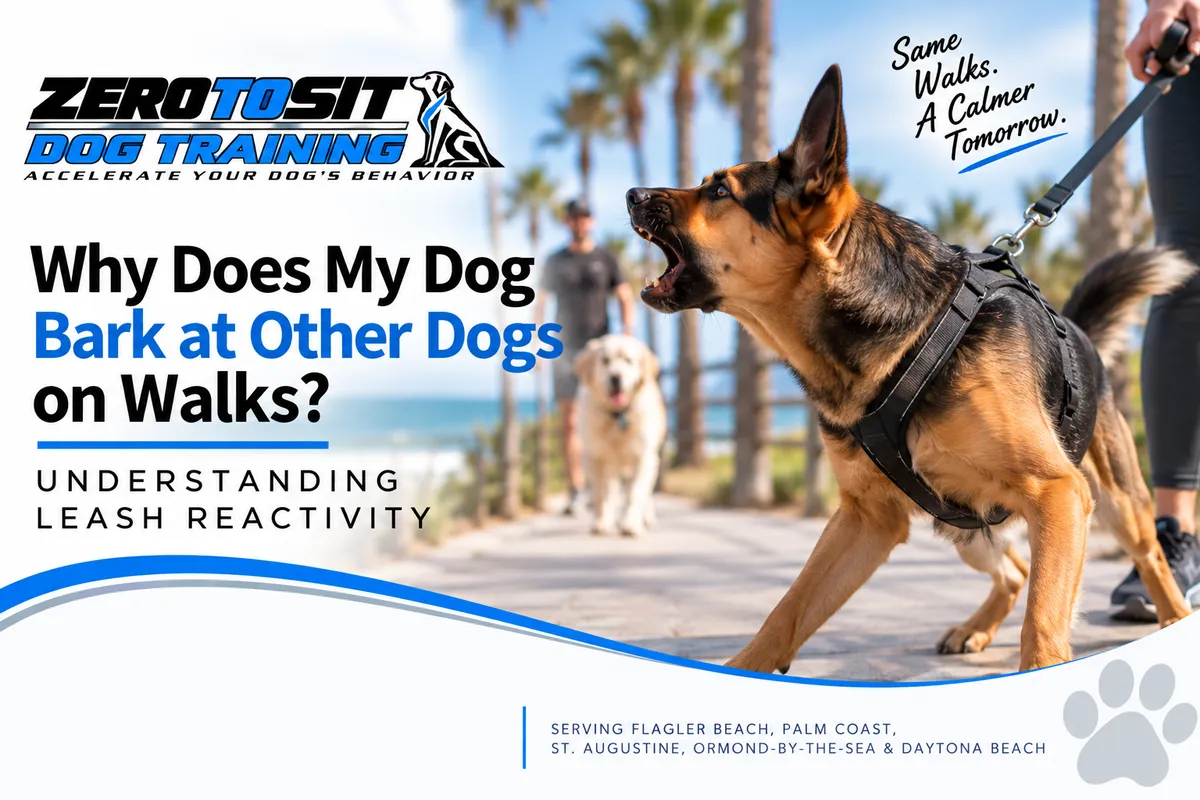
Why Does My Dog Bark at Other Dogs on Walks? Understanding Leash ReactivityNew Blog Post
Why Does My Dog Bark at Other Dogs on Walks? Understanding Leash Reactivity
By Zero To Sit Dog Training | Serving Flagler Beach, Palm Coast, St. Augustine, Ormond-by-the-Sea and Daytona Beach, Florida
You’re walking down the street with your dog when another dog appears in the distance.
Within seconds, your dog changes.
They may begin staring, pulling, whining, barking, lunging or completely ignoring you.
What started as a peaceful walk suddenly becomes stressful.
If this sounds familiar, your dog may be experiencing leash reactivity.
Leash reactivity is one of the most misunderstood behaviors dog owners deal with. It can look dramatic, aggressive or even unpredictable, but the behavior can come from several very different emotional and behavioral causes.
At Zero To Sit Dog Training, we work with families throughout Flagler Beach, Palm Coast, St. Augustine, Ormond-by-the-Sea, Daytona Beach and surrounding Northeast Florida communities who are struggling with dogs that become difficult to manage around other dogs, people and everyday distractions.
Understanding what leash reactivity actually is is the first step toward understanding your dog.
What Is Leash Reactivity?
Leash reactivity is an exaggerated behavioral response that occurs when a dog encounters a particular trigger while restrained by a leash.
The trigger might be another dog, a person, a bicycle, a skateboard, wildlife or something else in the environment.
The reaction can include:
• Barking
• Lunging
• Growling
• Whining
• Pulling
• Spinning
• Jumping
• Intense staring
• Freezing
• Becoming completely fixated
• Ignoring the owner
• Trying to move toward or away from the trigger
One of the reasons leash reactivity is so confusing is that the outward behavior may look very similar even when the underlying motivation is completely different.
Two dogs can both bark and lunge at another dog, yet one may be excited and frustrated while the other may be fearful and trying to create distance.
That distinction matters.
Reactivity Does Not Automatically Mean Aggression
One of the biggest misconceptions about leash reactivity is that every reactive dog is aggressive.
That is not necessarily true.
Reactivity describes the intensity of the dog's response.
Aggression describes behavior that may be intended to threaten, injure or create distance.
There can certainly be overlap between the two, but they are not identical.
A dog that barks and lunges because they desperately want to greet another dog can appear just as dramatic as a dog that genuinely does not want another dog near them.
From the owner's perspective, the behavior may look almost identical.
The motivation behind it may be completely different.
What Does a Reactive Dog Look Like Before the Barking Starts?
Many owners first notice reactivity when the barking or lunging begins.
But the behavior often starts much earlier.
A dog may begin showing subtle changes as soon as they notice the trigger.
You might see:
• A sudden hard stare
• The mouth closing
• The body becoming stiff
• Weight shifting forward
• Ears changing position
• Tail posture changing
• Breathing changing
• Slowing down
• Accelerating toward the trigger
• Refusing to look away
• Increased tension on the leash
These early behaviors can be easy to miss.
By the time the dog is barking, lunging or spinning at the end of the leash, the reaction has already escalated significantly.
Why Are Some Dogs Reactive on Leash?
There is no single cause of leash reactivity.
The behavior can develop for several reasons, and in many cases more than one factor is involved.
Frustration Based Reactivity
Some dogs become reactive because they want access to something and the leash prevents them from getting there.
The dog may want to greet another dog, chase a squirrel, approach a person or investigate something interesting.
The leash creates a barrier.
That barrier can create frustration.
As frustration increases, the dog may begin pulling, whining, barking or lunging.
This can be especially common in dogs that have become accustomed to greeting other dogs frequently.
If a dog expects that seeing another dog means they should be allowed to approach, being prevented from doing so can create a strong emotional reaction.
Fear Based Reactivity
Other dogs react because they are uncomfortable, nervous or fearful.
For these dogs, barking and lunging may be an attempt to make the other dog or person move away.
The behavior may look aggressive, but the underlying motivation can be insecurity.
The dog may be communicating:
“Stay away from me.”
This type of reaction can develop after a frightening experience, poor early socialization or simply because of the dog's individual temperament.
Overexcitement
Some dogs become so stimulated by seeing another dog that they lose control of themselves.
This is especially common in young dogs, highly social dogs or dogs that have difficulty regulating excitement.
The dog may not be fearful or aggressive at all.
They are simply overwhelmed by the excitement of the situation.
That excitement can quickly turn into barking, jumping, pulling and lunging.
Lack of Neutrality
Many owners believe socialization means their dog should meet as many dogs and people as possible.
But constant interaction can sometimes create the opposite of what owners actually want.
A dog may begin believing that every dog is an opportunity to play.
Every person is someone to greet.
Every distraction deserves attention.
Eventually, the dog may have difficulty simply existing around those things without interacting with them.
True socialization includes neutrality.
A well socialized dog should be able to see another dog, person or distraction without feeling that they must engage with it.
Previous Negative Experiences
A frightening interaction with another dog can have a lasting impact.
A dog that has been attacked, rushed, cornered or repeatedly overwhelmed by other dogs may begin anticipating that future encounters will also be uncomfortable.
Even one negative experience can change how a dog perceives similar situations.
For some dogs, the reaction becomes stronger over time because they begin expecting conflict before it actually happens.
Genetic and Temperament Factors
Not every behavioral issue is created solely by the owner or the dog's environment.
Genetics and temperament matter.
Some dogs are naturally more confident.
Others are more cautious.
Some recover quickly from stressful experiences.
Others remain affected by them much longer.
Breed tendencies, individual temperament, early development and inherited traits can all influence how a dog responds to the world.
That is one reason two dogs raised in the same home can behave completely differently.
Learned Behavior
Dogs also learn from repetition.
If a dog barks and lunges every time another dog approaches and that dog eventually disappears, the reactive dog may learn that the behavior was successful.
From the dog's perspective, they reacted and the other dog went away.
That pattern can become stronger with repetition.
Over time, the reaction may begin happening sooner and with greater intensity.
Why Does My Dog Only React to Certain Dogs?
This is another common question.
Some dogs react to every dog they see.
Others react only to certain dogs.
Possible factors can include:
• Size
• Sex
• Body language
• Energy level
• Movement
• Distance
• Previous experiences
• Breed appearance
• Whether the other dog is staring
• Whether the other dog is approaching directly
Dogs notice details that humans sometimes overlook.
Your dog may appear inconsistent, but there may actually be a pattern in what triggers the reaction.
Why Is My Dog Fine With Some Dogs but Reactive With Others?
Dogs are individuals.
Just as people do not feel equally comfortable around everyone they meet, dogs may feel differently around different dogs.
A dog may be comfortable around familiar dogs but uncomfortable around strangers.
They may tolerate calm dogs but react strongly to dogs that rush toward them.
They may be fine with one size or play style and uncomfortable with another.
That does not necessarily mean the dog is unpredictable.
It may mean the owner has not yet identified the specific conditions that influence the behavior.
Why Is My Dog Reactive on Leash but Fine Off Leash?
This is one of the most confusing situations for dog owners.
A dog may appear social and relaxed around other dogs when off leash yet bark and lunge when restrained.
The leash changes the entire interaction.
When off leash, a dog has more control over distance.
They can approach.
They can move away.
They can curve around another dog.
They can pause.
They can retreat.
On leash, many of those options disappear.
The dog may feel restrained, frustrated or trapped.
That restriction can change the dog's emotional response dramatically.
Barrier Frustration
Leashes are not the only barriers that can create reactive behavior.
Dogs may show similar reactions behind:
• Fences
• Windows
• Gates
• Crates
• Car windows
• Patio barriers
This is often referred to as barrier frustration.
A dog may behave very differently when separated from something by a physical barrier compared with how they behave when direct interaction is possible.
The Role of Distance
Distance can have a major impact on reactivity.
A dog may notice another dog from 100 feet away and remain relatively calm.
At 50 feet, they may begin staring.
At 20 feet, the body may become tense.
At 10 feet, barking and lunging may begin.
This illustrates that reactivity is not always simply about whether the trigger is present.
It is often also about how close that trigger is.
Each dog has a different level of tolerance.
What Does “Over Threshold” Mean?
You may hear trainers use the term threshold when discussing reactive dogs.
A dog's threshold is the point at which the intensity of the situation becomes difficult for them to handle.
Below threshold, the dog may still be aware of the trigger but remain capable of processing information.
As the dog gets closer to threshold, their focus on the trigger increases.
Once the dog goes over threshold, the reaction may become intense.
At that point, the dog may bark, lunge, growl, pull or completely tune out everything else around them.
Understanding this concept helps explain why a dog can appear calm one moment and completely out of control the next.
Trigger Stacking
Another concept that can affect reactive dogs is trigger stacking.
This happens when several stressful or exciting events happen close together.
For example, a dog may experience:
A loud garbage truck.
Then an unfamiliar dog.
Then a skateboarder.
Then a stranger reaching toward them.
Each event by itself might be manageable.
But together, they can build on one another.
By the time the dog encounters the final trigger, their tolerance may already be reduced.
This can make it seem like the dog reacted “out of nowhere” when in reality several events contributed to the reaction.
Why Reactivity Can Get Worse Over Time
Reactive behavior can become more intense if it is repeatedly practiced.
The dog may begin reacting at greater distances.
The reaction may start sooner.
Recovery may take longer.
Owners may also begin changing their own behavior.
They may tighten the leash whenever another dog appears.
They may become tense.
They may cross the street immediately.
They may avoid certain routes.
Eventually, both the dog and owner may begin anticipating the reaction before it happens.
What started as an occasional problem can slowly become a pattern.
Is My Dog Being Protective?
Many owners describe reactive behavior as their dog being protective.
Sometimes that may be part of the picture.
But protection is often overused as an explanation.
A dog barking at another dog does not automatically mean they are defending their owner.
The behavior could be caused by fear, frustration, excitement, insecurity or learned behavior.
Calling every reactive behavior “protective” can sometimes prevent owners from understanding what is actually happening.
Is My Dog Dominant?
Dominance is another word frequently used to explain reactive behavior.
But leash reactivity cannot simply be reduced to dominance.
Dogs can react for many reasons, and labeling the dog as dominant often tells us very little about the actual emotional or behavioral cause.
The more useful question is:
What is causing this particular dog to react in this particular situation?
Can Puppies Become Reactive?
Yes.
Reactive behavior can appear in puppies and adolescents.
Sometimes it develops gradually as the dog matures.
A puppy that once seemed comfortable around everything may begin showing more caution, excitement or frustration as they enter adolescence.
Changes in confidence, hormones, social development and life experiences can all influence behavior during this period.
That is one reason early experiences matter so much.
Can Adult Dogs Suddenly Become Reactive?
Yes.
An adult dog can begin showing reactive behavior even if they did not previously have a major issue.
Possible causes can include:
• A frightening encounter
• Changes in environment
• Increased stress
• Repeated negative interactions
• Changes in routine
• Maturing behavior
• Physical discomfort
• Changes in vision or hearing
Sudden behavioral changes should always be taken seriously, particularly when they are dramatically different from the dog's previous behavior.
Reactivity Is Often Context Specific
A dog may behave perfectly in one environment and struggle in another.
For example, your dog might be calm:
At home.
In the backyard.
Around familiar dogs.
On a quiet street.
But reactive:
On a narrow sidewalk.
Inside a busy park.
Near a restaurant patio.
Around unfamiliar dogs.
In crowded public areas.
That difference can become even more noticeable in active coastal communities like Flagler Beach, Palm Coast, St. Augustine, Daytona Beach and Ormond-by-the-Sea, where dogs may regularly encounter beach traffic, outdoor dining, bicycles, tourists, other dogs and busy walking areas.
This is why owners often say:
“My dog knows better.”
The dog may know certain behaviors in one environment but respond very differently when the level of distraction or emotional pressure changes.
Why Leash Reactivity Is So Stressful for Owners
Leash reactivity doesn't only affect the dog.
It can dramatically change the owner's life too.
Owners may begin avoiding walks.
They may stop taking their dog to public places.
They may walk extremely early or late to avoid other dogs.
They may feel embarrassed when their dog reacts.
They may worry about losing control.
They may stop taking their dog to beaches, parks, outdoor restaurants or other places they had hoped to enjoy together.
Over time, what began as barking at another dog can become something that limits the relationship between the owner and their dog.
Every Reactive Dog Is Different
Perhaps the most important thing to understand is that reactivity is not a diagnosis.
It is a description of behavior.
The underlying cause must still be understood.
One dog may react because of fear.
Another may react because of frustration.
Another may be overstimulated.
Another may have developed a strong learned behavior.
And another may have several of these factors happening at the same time.
That is why there is no single explanation for every reactive dog.
When Should You Take Reactivity Seriously?
Any reactive behavior that is escalating, difficult to control or affecting your ability to safely enjoy your dog deserves attention.
It becomes especially important if your dog:
• Has bitten another dog or person
• Has attempted to bite
• Cannot be physically controlled during a reaction
• Redirects onto the leash or owner
• Is becoming reactive at greater distances
• Takes a long time to recover after seeing a trigger
• Is becoming increasingly difficult to take into public
Reactive behavior can range from mild frustration to serious safety concerns.
Understanding where your dog falls on that spectrum is important.
Dog Reactivity Training in Flagler Beach, Palm Coast, St. Augustine, Daytona Beach and Ormond-by-the-Sea
If your dog barks, lunges, pulls or becomes difficult to control around other dogs, Zero To Sit Dog Training can help you understand what is happening and what may be contributing to the behavior.
We provide private dog training for families throughout Flagler Beach, Palm Coast, St. Augustine, Daytona Beach, Ormond-by-the-Sea and surrounding Northeast Florida communities.
Every reactive dog is different.
That is why we start with a free consultation to learn about your dog, their history, what triggers the behavior and what you would ultimately like life with your dog to look like.
The first step is understanding the dog in front of you.
Ready to learn more? Visit ZeroToSit.com to schedule your free consultation.
